
What Is Web Analytics In Digital Marketing? How It Works And Why It Matters
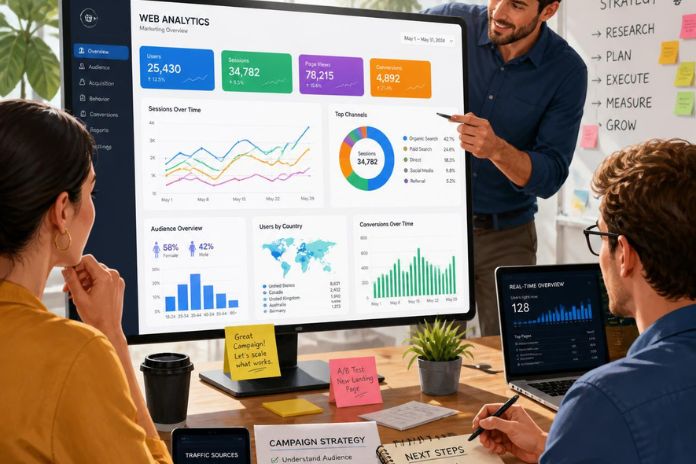
Imagine then setting up a shop selling real clothes on a busy high street. Your store is on the corner of a busy shopping mall, and from your cashier desk, you can see the whole lot. You “monitor” how many people stop and look through the window, how many actually come inside, and which shirts from your range they pick up once inside. This process is what “Web analytics in digital marketing” does for your online business.
- The store owner sees that ten people have entered, but only three decide to purchase the blue shirt after trying it on; others get irritated by the shoe display and leave. The store owner sees everything and knows exactly what to change to increase sales.
- If you can see everything with your own eyes, you understand what strategies are effective. You have maintained the front window display and pushed shopping shoes into chaos.
- Well, in a moment, picture yourself operating that same store, but now you are wearing a dense blindfold. You can hear the cash register ring dozens of times, but you have no clue who bought what, what they possibly looked at, or why hundreds of others left empty-handed.
Managing A Digital Marketing Campaign
Imagine managing a digital marketing campaign without web analytics; it is like running a shop while wearing a blindfold.
Web analytics is like taking the blindfold off. It is the process of observing, recording, monitoring and analysing everything visitors do when they arrive on your website. Digital marketers often struggle to find this information. for digital marketers. It is survival.
Why Digital Marketers Rely On Analytics
Marketing is expensive. You have paid a large chunk of your budget on Facebook video campaigns, Google Search AdWords, email newsletters and paid Instagram promotions.
- Without analytics to track your spending and the results of your marketing efforts, you are just another businessman throwing money into the internet and hoping for sales.
- You could end up with ten sales, but you would have no way of knowing whether they resulted from your expensive Facebook campaign, a very inexpensive Facebook campaign, or a really cheap Google ad.
- Analytics provides you with a completely accurate answer. It shows you the shortest route your customer takes before the dollars start flowing.
- Once you realise that fifty per cent of your profit comes from your email newsletter, you can cut back on Twitter ads and concentrate on writing better emails, thereby allocating your budget to where it generates revenue.
The Numbers That Actually Matter
The first time you log into an analytics tool, you will see hundreds of charts and figures. It looks very impressive and perplexing. Good digital marketers only concentrate on a handful of metrics. There is too much other information.
Traffic Sources (Origin)
This data tells you exactly how people got to your site. Did they go directly to your web address? Did they follow a link in a newspaper article? Did they happen upon your site through a YouTube video? Knowing where your visitors are coming from lets you know which marketing efforts are producing the most results.
Bounce Rate (The Quick Exit)
A “bounce” occurs when someone lands on your site and leaves without clicking on anything or visiting another page. A higher bounce rate typically indicates a significant issue. It means the visitor didn‘t find what they were looking for. Perhaps your ad was offering a 75% discount, and the website did not deliver the coupon code. Or perhaps your site took forever to load, and the reader gave up and left. Marketers watch bounce rates carefully.
Time On Page (Are they focused?)
Average time on page The metric is the number of seconds or minutes that a user stays on a certain page. It will tell you, for instance, that if you write a 10,000-word very helpful article, but you average only twelve seconds on the page, you have a problem.
Readers are leaving before they even finish the first paragraph. You take this information and go back and rewrite your intro; make it more enticing.
Conversion Rate (The Ultimate Goal)
A conversion takes place when a visitor performs the desired action. This desired action can include purchasing a new pair of shoes, subscribing to your weekly newsletter, or downloading a free trial version of your software.
If a thousand visitors come to your landing page and fifty subscribe to your weekly newsletter, then you have achieved a five per cent conversion rate. And digital marketing is about getting this figure up.
How Marketers Actually Use The Data
Let‘s take an example of real life to understand the phenomenon.
- Suppose you have an online shop that sells high-quality coffee beans. You roll out a new marketing campaign.
- You spend five hundred dollars on Instagram advertisements that clicked through to a new dark roast coffee.
- Within three days you log into your analytics dashboard, and it reveals how your Instagram advert brought 2000 visitors to your site.
- You are on cloud nine! However, you then check your sales. From those two thousand visitors, not a single sale was made.
- Without analytics, you might mistakenly conclude that your coffee is too expensive or that all the efforts on Instagram ads are a waste of time and money, leading you to abandon the entire experiment.
- But since you have analytics, you go further. You examine the device data. Software reveals that 95 per cent of those Instagram visitors used their mobile phones to explore your site.
- Next you move the checkout page data. You realise that not one mobile visitor did anything and left their shopping cart or left their shopping cart on the payment page.
- You grab your phone, go to your site, and try to buy the coffee. Right away, you see the problem. On a smartphone, the “Pay Now” button is hidden underneath a huge flash ad. Your customers can‘t bring themselves to pay you.
- You pick up the phone and call the web developer. You quickly fix the mobile button and turn the ad back on.
- The next day, sales are pouring in. But the data didn‘t just show you a broken button; it saved your entire marketing campaign.
Segmenting Your Audience
Good marketers do not treat all web visitors as a single homogeneous audience. They find a way to categorise the traffic with the help of analytics.
For instance, you can also break down your data by comparing first-time visitors to repeat customers. It is common to discover that return visitors buy more frequently, with higher value, as a result.
With this information in mind, you could develop a marketing plan that encourages repeat visits. encouraging repeat visits.
Location: You can target your advertising based on specific geographic areas. If, for example, your data indicates that a significant per cent of your winter coat sales are made by people living in Chicago, you can cease advertising to the sunny Floridians.
Your advertising budget is more effective when you target individuals who are genuinely interested in your products.
Testing Is Ongoing, And This Newly established term is being introduced in the field of computer science. In the meantime, the pen tests until the pen drops, and the subject is continually developing.
The wonderful thing about web analytics is that it enables you to test your crazy ideas without endangering your whole business. This process is known as A/B testing by marketers.
You Come Up With Two Separate Product Page Designs.
- Version A has a green Buy button and a video playing at the top of the page, while version B has a red Buy button and an enlarged photo at the top.
- When you run the tests, you direct half of your visitors to version A and half to version B using your analytics software.
- After one week, you look at the figures. You notice that Version B has got twenty per cent more sales than Version A.
- You change your website to Version B. Were you making an educated guess about which version appeared more appealing?
- Instead, you allow your customers to provide feedback, to some extent, through their behaviour.
Wrapping Up
Running online ads without looking at your data is just guessing. Today, relying solely on intuition is insufficient for business growth. You need to know exactly what your customers want, where they get confused, and what makes them finally buy.
Yes, setting up tools like Google Analytics takes a little time to learn. But once you see the real numbers, everything changes. You will stop wasting your money on ineffective ads, make much smarter choices, and clearly see how to grow your business.
Stop guessing and start tracking your website traffic today.
