
Data Mining Vs Web Mining In 2026
Most of the activities of businesses, institutions, governments and individuals involve data today. Companies collect data from many sources such as sales transactions, customer interactions, databases, applications, websites and more. Data collection alone doesn’t add much value. But the real benefit is in analysing that information and finding patterns that can lead to better decisions.” The two most common terms associated with this process are data mining and web mining.
The two concepts are closely related, but they do not mean exactly the same thing. Data mining is very extensive and can be applied to many types of data sets, whereas web mining is concerned with information available on the World Wide Web. It is useful for students, researchers, business professionals, and anyone dealing with large volumes of information to understand the difference between data mining and web mining.
What Is Data Mining?
Data mining is the science of finding intriguing patterns, relationships, trends and useful information in large sets of data. It includes aspects of statistics, databases, machine learning and pattern recognition to convert raw data into knowledge.
Organisations often have a wealth of historical information in their databases and data warehouses. Those records may not show important relationships when reviewed manually. Data mining techniques help identify them automatically / semi-automatically.
For example, a supermarket might look at thousands of purchase records and determine that customers who buy bread often tend to buy butter. This data businesses can utilise for product placement, promotions, or recommendation systems. by the business for product placement, promotions or recommendation systems.
Besides structured data, there is some semi-structured and unstructured information. In addition to structured data, we can also extract some semi-structured and unstructured information. The traditional techniques are classification, clustering, association, regression, anomaly detection and prediction.
What Is Web Mining?
Web mining is an extension of data mining to information associated with the Web. The information available includes web pages, hyperlinks, website databases, server logs, search activity, online documents, and user interactions. This information can be obtained from web pages, hyperlinks, website databases, server logs, search activity, online documents, and user interactions.
The amount of information on the web is enormous. Some of it is text, but other information is images, videos, links, tables, metadata or browsing records. Web mining provides techniques for extracting useful knowledge from such sources.
For instance, a shopping website can evaluate the browsing and purchase patterns of its visitors to know which products are catching their attention. Then it can use this insight to improve search results or make more relevant recommendations.
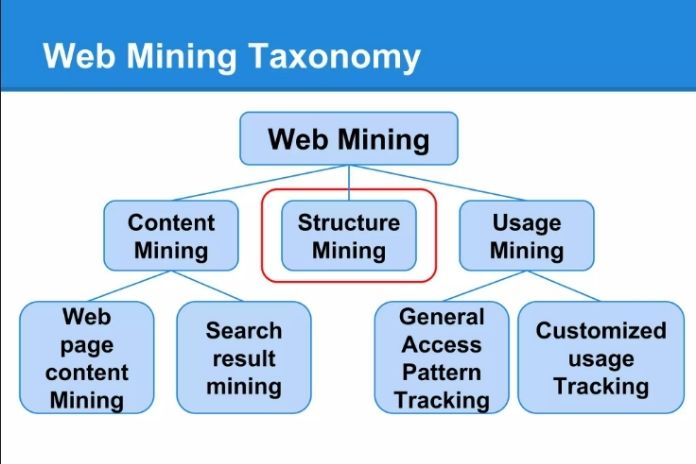
Web mining is usually divided into three major categories: web content mining, web structure mining and web usage mining.
Mining of Web Content
Web content mining deals with the information contained in web resources. This can include articles, product descriptions, news stories, documents, images and other material online.
Web content: Search engines process and organise web content using sophisticated techniques, enabling users to find relevant information. Search engines use sophisticated techniques to help users locate relevant information. Businesses can also analyse online content to gauge customer opinions, product discussions, and market trends.
Mining Web Structure
Web structure mining studies the relationship between web pages and other web resources. Hyperlinks are important because they link pages together.
By analysing these links it is possible to find out which pages are closely related or which pages are more important in a network. Web structure mining: Link analysis is a significant example.
Mining Web Utilisation
Web usage mining is the study of user interaction with websites and web services. Data may include page views, paths taken, search terms, length of session, clicks and other activity records.
An example is an internet retailer who can study how visitors move around his website. If many people leave the website after a certain page, the company can see if the page is confusing or slow or is missing useful information.
Difference Between Web Mining and Data Mining
The big difference is what data is being analysed and where it’s coming from. Data mining is a broad notion that can be used on data from many sources. Web mining is more specialised and focused on web-related information.
Data mining can include customer databases, banking records, medical datasets, manufacturing information, educational records, or sales transactions. Web mining, meanwhile, is mainly concerned with data created by or accessible via websites and online systems.
Yet another difference is the complexity of the data. Usually, traditional data mining is performed on well-structured tables having fields and records. Web data are often much less regular. A website can have text, hyperlinks, images, videos, HTML elements, metadata and dynamically generated material. So web mining may require some additional techniques for collecting, cleaning and interpreting the information.
The goals may also differ. Data mining is frequently used to support prediction, classification, business intelligence, fraud detection, customer analysis, and decision-making. Web mining is typically used for search, website improvement, personalisation, recommendation systems, analysis of online behaviour, and content discovery.
Key Differences in the Summary
Data sources include databases, warehouses, applications, files, and other data sets such as websites, web pages, links, logs, and internet activity.
Scope: Comprehensive More specialised
Data nature is often structured but may take other forms. Often semi-structured or unstructured
The main focus is on data relationships and patterns. Web content, web structure and user behaviour
Fraud detection, customer segmentation examples Search, recommendations and site analysis
Popular techniques: classification, clustering, regression, association rules Content extraction, link analysis, usage analysis and data mining techniques
Data Mining Methods
There are many techniques in wide use in data mining. Classification means records are grouped into predefined categories. A financial institution might, for example, tag transactions as normal or potentially fraudulent.
Clustering groups similar records without requiring pre-defined categories. For example, a company might group customers into clusters based on their purchasing behaviour.
Association rule mining discovers relationships between items or events. Retailers often use it to understand which products are bought together.
Regression and predictive analysis can be used to predict future values using past information. These approaches businesses can use to estimate sales or demand.
The techniques are not industry specific. They can be used whenever enough data is available and it is necessary to identify recognisable patterns.
Methods Utilised in Web Mining
Web mining uses many standard data mining techniques but also employs techniques tailored to the nature of online information.
Web content extraction can be used to extract information relevant to web documents. Textual information can be analysed with natural language processing techniques, and relevant documents can be retrieved with information retrieval techniques.
Link analysis can be used to study relationships between web pages. It can show connections within a website or a larger web network.
Web usage analysis is about what visitors do. Businesses can see navigation paths, clicks, searches and sessions to see how users interact with online services.
Data Mining Applications
Data mining has many applications. In banking, it can help identify unusual patterns of transactions. In healthcare research, it can help researchers analyse large data sets and discover relationships that may be worth further study.
Retailers use it to understand buying behaviour and improve inventory planning.
Schools can use student performance data to identify trends related to academic performance. Manufacturing companies can use production information to identify defects or improve operational efficiency.
The common goal is to extract useful knowledge from available data and use it for decision-making.
Applications of Web Mining
Web mining has special significance for organisations that depend on online platforms. Search engines extract information from the Web and then organise and retrieve relevant content. E-commerce sites use browsing and buying behaviour to improve recommendations and personalisation.
Companies also may study online conversations and reviews to learn how customers view products or services. Administrators of the website may evaluate usage patterns for the purpose of improving page design, navigation, and overall user experience.
Large amounts of information online can also be beneficial to news organisations, digital marketers, researchers, and social media platforms.
Relationship Between Web Mining and Data Mining
Web mining is an application of data mining in a very particular domain. It is useful to think of web mining in this way. The two fields share methods but can have different data sources and practical goals.
Data mining is used to analyse a company’s entire customer database, including purchases, payments, and demographic data. It can also use web mining separately to analyse how those customers navigate its website. The combination of these approaches may provide a more complete picture of customer behaviour.
Therefore, data mining and web mining should not be considered as competing technologies. In many practical situations they are complementary.
Summary
Data mining and web mining are entirely different in the type and source of data they investigate. Data Mining is the process of extracting useful patterns and knowledge from large data sets such as banking records, customer databases, medical data, sales data, etc. Web mining deals with web-related information such as web content, website structures, links, and user activities.
Both use techniques such as classification, clustering, pattern discovery and statistical analysis. But web mining deals with the special features of online information. In simple words: data mining deals with general datasets, web mining looks for knowledge from web information and activities.
